


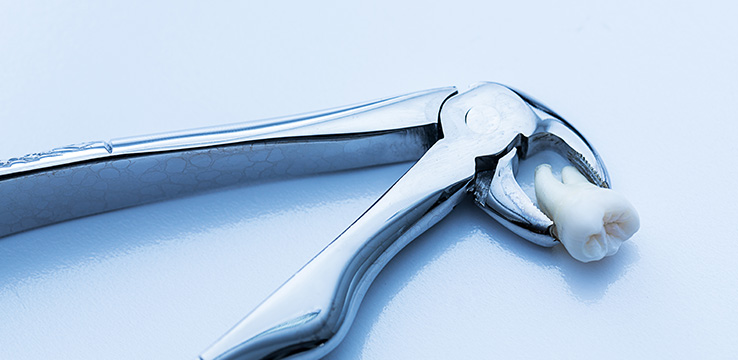
We understand that wisdom tooth removal can be a scary prospect. However sometimes it is unavoidable. At Shore Dental you are in safe, experienced hands; we are positive your experience at Shore Dental will be a good one.
What are wisdom teeth?
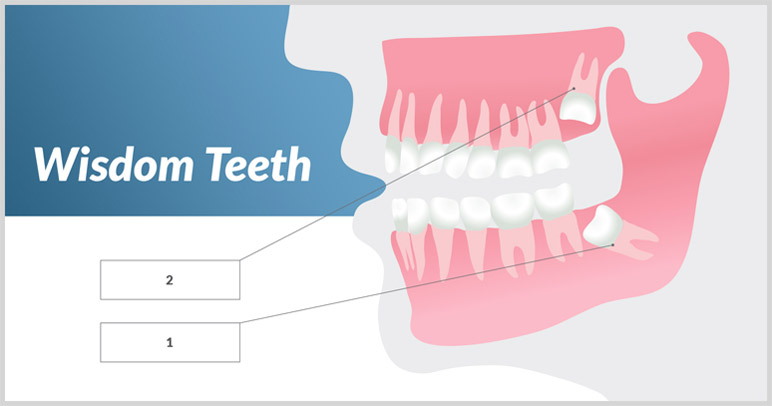
Your wisdom teeth are large molar teeth that emerge at the very back of your mouth, usually between the ages of 17 to 24. As humans have evolved as a species and our eating habits have changed, we no longer need our wisdom teeth to digest tough foods. Some people never develop wisdom teeth, while others need to have all four removed. It is very common to need your wisdom teeth removed, as our mouths are not always large enough to accommodate wisdom teeth. As they grow they can move your other teeth, become wedged or impacted, causing discomfort or infection.
Symptoms of wisdom teeth
As wisdom teeth emerge, if there is not enough space, or they grow crooked, they can cause pain and disease. Some common signs and symptoms include:
 Swelling of gums near the back of the mouth
 Soreness and stiffness opening your jaw
 Pain when chewing
 Bad breath
 A bad taste in your mouth
What is an impacted wisdom tooth?
Most adults grow 32 adult teeth, however as we have evolved, many of our jaws are not large enough to accommodate this many teeth. When there is insufficient space for wisdom teeth to grow, they become impacted. This can cause infection, pain, and difficulties chewing and cleaning.
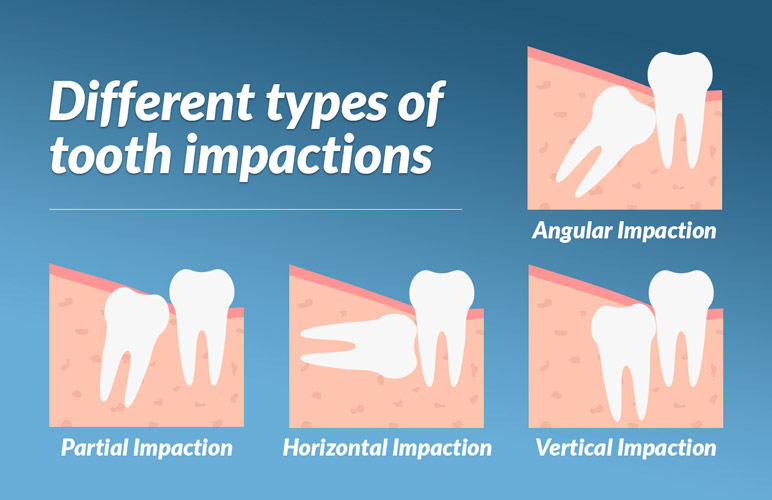
Partial impaction
A partially impacted tooth is when the tooth can partially erupt through the gum. You may be able to use the tooth to a certain extent, however because of its position it can be difficult to clean, increasing the risk of infection and decay.
Complete impaction
A complete impaction is when there is no space for the tooth to erupt at all. It remains embedded in the jaw, sometimes at an angle, putting pressure on adjacent teeth. A completely impacted wisdom tooth needs to be surgically removed.
Do all wisdom teeth need removing?
No. Some people have plenty of room on their jaw for wisdom teeth to grow naturally. Others however, do not, which can cause a number of serious problems. If your wisdom teeth need removing your dentist will usually recommend this to be done in your teens or early twenties, before the tooth structure and roots are fully developed.
Infection
Gum infections are very common with impacted wisdom teeth. Without sufficient room for the tooth to break the surface, the gum becomes swollen and infected. This can be quite painful, and cause problems chewing and swallowing naturally.
Cysts
A cyst, or balloon of fluid, often forms around an impacted wisdom tooth. The cyst gradually expands, putting pressure on the surrounding bone and adjacent teeth. If left untreated they can destroy parts of your jawbone and teeth.
Overcrowding
When there is insufficient room for wisdom teeth to grow on your jaw, they will force their way up, moving the other teeth out of place. This is most noticeable with front teeth, especially if they have been straightened with braces in the teenage years.
Damage to other teeth
When a wisdom tooth grows without enough room, it will put pressure on the other teeth. Especially if a tooth grows on an angle, which is quite common, it can force the adjacent teeth and gums to decay or crack.
What happens if I don’t have my wisdom teeth removed?
As teeth age, their roots grow longer and the jaw bone stronger and more dense. As the roots grow deeper, they get close to the nerve, which if affected can be very painful and cause further complications. The older a patient is when they have oral surgery to remove wisdom teeth, the more at risk they are of complications, infections, and usually experience a longer recovery period.
Preparing for wisdom tooth removal
Prior to your wisdom tooth removal, your dentist will discuss the surgery with you and any specific measures you need to take to prepare. Be sure to advise your doctor of your entire medical history, including any current medications, allergies, especially to anesthesia, and if you smoke. Wisdom teeth can be extracted under local anaesthesia or general anaesthesia, depending on the difficulty of the procedure.
What to expect from wisdom tooth surgery
Wisdom tooth removal is a short procedure, completed within a couple of hours. The position of and how impacted your teeth are will dictate the type of oral surgery you need, however most people choose to be treated with a simple local anaesthetic.
For the nervous patient sedation is available. This will be performed by an experienced anesthetist to ensure your safety. Most wisdom tooth removal surgeries take between 30 minutes to one hour. Your dentist will also advise that you will need a friend or family member to collect you after the surgery, as you will not be able to drive.
If your wisdom teeth have emerged from your jawbone, they can be removed like any other tooth extraction. Once the anaesthetic has kicked in, your dentist will widen the tooth socket and move the tooth until it is loose enough to be pulled out.
If the tooth is completely impacted, or growing on an angle, your dentist may need to cut through the gums and jawbone to reach and extract the tooth. This may require stitches to close the wound, which will usually dissolve in seven to 10 days time.
How quickly will you recover?
After any surgery under local or general anaesthetic, you will need to rest until the effects of the anaesthetic have worn off.
For surgery under local anaesthetic, your mouth may feel numb for a few hours. During this time, avoid any hot food and drink, and do not chew on the affected area as you may cause damage without realising. You may need a few more days to rest until the pain has subsided and you can return to normal habits.
If your oral surgery is performed under sedation, you will need to arrange to have a friend or family member to escort you home after your surgery. If stitches are used to secure the wound, they should dissolve within 10 days after the surgery.
You may also have some facial swelling, bruising and pain for one to two weeks.
Pain relief and care
Before going home, your dentist or oral surgeon will give you options for pain relief when the anaesthetic wears off. You may be given antibiotics, pain killers or mouthwash to use at home. You can also use anti-inflammatory medications such as ibuprofen. For more information, see our dental pain relief section. You can also read about dental sedation here.
After oral surgery take the following measures to ensure the fastest recovery:
 Bite gently on gauze periodically to ease pain and spot bleeding
 Gently rinse your mouth with warm, Difflam C for the first day
 Be careful not to rinse too vigorously to avoid disturbing any blood clots
 Brush teeth as normal, however avoiding the affected area
 If your gums start bleeding, bite down on a clean piece of gauze until it has subsided
 Avoid smoking for as long as possible, at least the first 24 hours
 Antibiotics prescribed may interfere with birth control medication
 Avoid eating hot foods and drinks until the anaesthetic has worn off or you risk burning yourself without realising
 Eat soft and liquid foods until your jaw and teeth feel less tender and stiff
What are the risks of wisdom tooth removal?
While most people do not experience any adverse side effects, if you do experience any of these symptoms, you should contact your dentist.
 Bleeding that doesn’t subside with pressure
 Difficulty breathing or swallowing
 Severe pain that doesn’t improve with painkillers
 A temperature
 Swelling that doesn’t subside after a few days
Numbness in the mouth or lips that continues after a few days
Swelling that doesn’t subside after a few days
Numbness in the mouth or lips that continues after a few days
 A general feeling of malaise
Dry socket treatment and information
One of the most common complications to occur from wisdom tooth removal surgery is a dry socket. When your tooth is removed a blood clot forms in the hole in the bone. A dry socket occurs when this blood clot breaks away, exposing the wound, including bone and nerves, to air, fluid and food. This causes severe pain and prolongs the healing period.
Signs you may have a dry socket include:
 Severe throbbing pain that starts about two days after your tooth is removed
Bad breath
Unpleasant taste in your mouth
Severe throbbing pain that starts about two days after your tooth is removed
Bad breath
Unpleasant taste in your mouth
 It appears to look dry, and white bone may be visible, as opposed to a dark blood clot
What increases the risk of dry socket?
Some patients are more at risk of developing a dry socket, but usually it can be prevented by avoiding the following things:
Smoking, as exposure to nicotine reduces blood supply, making healing more difficult
 Poor oral hygiene can increase risk of infection
Hormonal changes and birth control medication in women can increase the risk of dry socket
Poor oral hygiene can increase risk of infection
Hormonal changes and birth control medication in women can increase the risk of dry socket
 Rinsing and spitting vigorously after surgery can dislodge a blood clot
 Drinking through a straw can dislodge a blood clot
How is dry socket treated?
If you experience any of these symptoms, contact your dentist immediately. Your dentist will do an examination to diagnose dry socket, before treating your symptoms.
Once diagnosed, your dentist will irrigate the socket to clear it of any debris from food. An analgesic dressing will be placed in the socket to cover any exposed nerves and bone, promoting healing and providing pain relief. You may also be advised to take anti inflammatory and pain relief drugs such as ibuprofen or paracetamol.
How much does wisdom tooth removal cost?
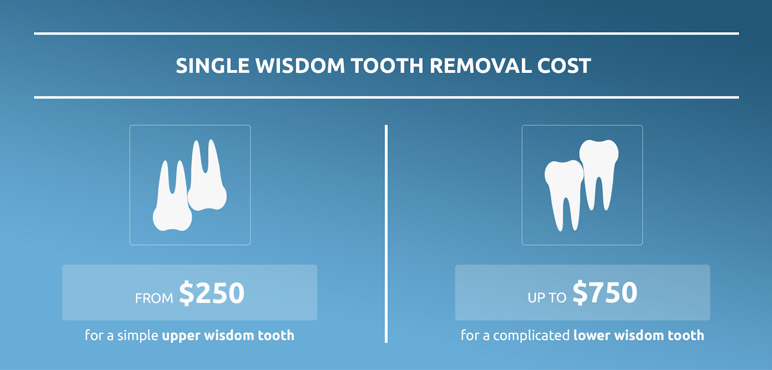
The cost of wisdom tooth removal surgery depends on a number of factors including the difficulty and length of the surgery. These factors all influence the cost and type of surgery you need:
 Your overall health
Your oral hygiene
Your overall health
Your oral hygiene
 How many wisdom teeth need to be removed
 The position of the teeth - erupted fully, partially impacted, fully impacted
 The type of anaesthesia best for you
Will my health insurance cover the cost of wisdom tooth removal?
Many health funds offer some cover for preventative and emergency oral surgery. At Shore Dental we accept all major health funds, allowing you to maximise your fund benefits. To find out what cover your health fund provides for wisdom tooth removal, you will need to contact them directly. Read more about health fund dental cover on our health funds page.
Are there any payment plans for wisdom tooth removal?
Wisdom tooth removal can be a costly procedure, and at Shore Dental we understand this can add great financial strain. To make your oral surgery as easy and pain free as possible on your bank account, we offer payment plans, which can be tailored to suit your individual situation.
Learn more about our finance options in our Dental Finance section.
Wisdom Tooth Removal Patient Case Studies
See examples of real Shore Dental patient case studies in our Smile Gallery.